

I have this hope that science is going to be able to end-to-end non-invasively decipher the androgen signaling network. Last week, we discussed how baseline testosterone concentrations are not predictive of the degree of adaptation in strength or hypertrophy from resistance training interventions HERE.
Muscle androgen receptor content has been related to resistance training-induced hypertrophy [1], but most people probably aren’t going to stab themselves in the quad (muscle biopsy) multiple times per year to answer this type of question at the individual level.
Thus, can knowing the sensitivity of one’s androgen receptor via genetic testing further explain the potential relationship between testosterone and muscle mass?
Previous research has been mixed, but the majority of studies have found that a higher number of CAG repeats (or a less sensitive androgen receptor) is associated with higher testosterone values [2-8]. The hypothesis is that the body compensates for a less sensitive androgen receptor by maintaining higher levels of testosterone.
The majority of these studies are in smaller sample sizes, and a paper was recently published with an n of over 181,000 males [9]. This analysis more definitively shows that a less sensitive androgen receptor likely leads to a higher baseline concentration of total testosterone. The mean and SD for CAG repeats within this population was 22 ± 3, which is similar to prior data. This was an older population with an average age of 57 ± 8 with a total testosterone of ~346 ± 106 ng/dL. Sex hormone binding globulin was 39.9 ± 16.8 nmol/L.
As you can see from the graphic below, the main statistically significant finding was a ~0.07 SD change in testosterone for every one SD change in CAG repeat length. That means if someone’s CAG repeat length was three repeats higher than the average, they had a ~7.5 ng/dL higher total testosterone.
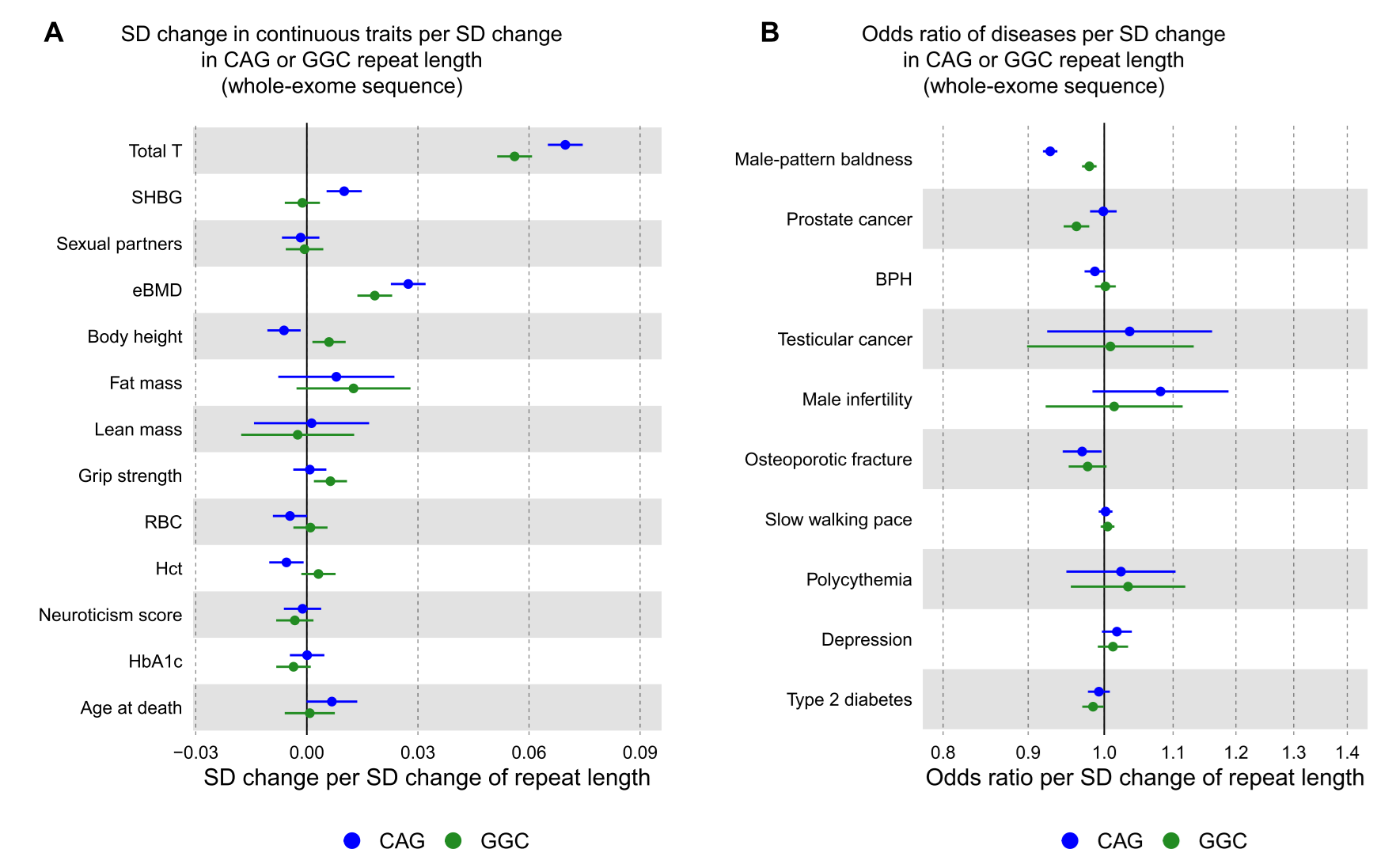
The likelihood of being two SDs above the mean is 2.28% so there is a small chance that someone could have a very insensitive androgen receptor and a ~15 ng/dL or a ~4% higher testosterone. This increase is statistically significant at the group level, but very likely real-world meaningless. This small of a change is going to be easily overwhelmed by the biological and analytic variation in total testosterone, as you can see HERE. The authors also found that higher GGC repeats were related to higher total testosterone of about the same magnitude, so there is a .05% chance that someone could be two SDs above the mean on both CAG and GGC repeats and have a ~30 ng/dL higher testosterone.
Bhasin provides a valid critique and summary of this paper below:
“These important findings on the significance of the trinucleotide repeats should be viewed in the context of some inherent limitations of the UK Biobank database. Total testosterone levels in the UK Biobank were measured using an immunoassay that has limited accuracy and precision in the low range. Free testosterone levels were estimated using an equation that assumes fixed values for the dissociation constants that are inconsistent with the dynamic conformational changes in the SHBG monomers because of the intermonomeric allostery and disregards the prevalent concentrations of other SHBG ligands such as DHT and estradiol. The estimates of bone mineral density by ultrasound of the heel are not a measure of bone mineral content or osteoporosis. The UK Biobank cohort is not a representative sample of the general population and suffers from healthy volunteer bias, survival bias, and recruitment bias from the inclusion of related individuals (8). The analyses by Sasako et al were limited to people of European ancestry. The International Classification of Disease-based diagnoses in electronic medical record are susceptible to inaccuracies.
The study by Sasako et al, by virtue of its large sample size and more accurate quantification of the CAG and GGC repeats in the AR gene, has substantially advanced our understanding of the role of these short tandem repeats in modulating testosterone’s effects and the risk of androgen-related disorders. Their finding that greater length of the CAG as well as GGC tracts is associated with higher testosterone levels is consistent with reduced transcriptional activity of the AR with longer repeat length. However, the overall effect is very small. These analyses do not reveal a significant relation between CAG and GGC tract length and the risk of prostate or testicular cancer, or infertility. In view of the small magnitude of the effect and the lack of significant association with the risk of androgen-related disorders, these data do not justify the evaluation of CAG and GGC tract length in clinical practice at present.”[10]
Interestingly, in the study by Sasako and colleagues, androgen receptor sensitivity was not related to lean body or fat mass measured via dual-energy X-ray absorptiometry, which you can see in the figure above. Results from smaller sample studies exploring the relationship between CAG and GGC repeats have been mixed, with some studies even finding that a less sensitive androgen receptor was associated with more muscle mass. In general, these studies have mostly resulted in small effect size findings [5, 6, 8, 11-13].
Guilherme and colleagues [12] seem to be the only authors who have investigated androgen receptor sensitivity and muscle mass and strength in bodybuilders and powerlifters. These subjects were professional bodybuilders and elite power athletes from Russia. The researchers split the sample at a CAG repeat length of 21, which resulted in equally sized groups. Individuals with higher CAG repeats had a ~16% higher absolute muscle mass, and a 413 lb ± 89 lb bench press compared to 344 ± 76 lb for those with <21 CAG repeats. They were also 2.2 times more likely to be a power athlete compared to a control population.
“It should be noted that in cohorts composed of older individuals, participants may be hypogonadal and, to some extent, sarcopenic, which can influence the association and make it difficult to compare these studies with ours…Longer alleles for the AR (CAG)n polymorphism were associated with greater muscle mass and strength in bodybuilders and power athlete status. An increase, but still within the normal physiological range, of CAG repeats in the NH2-terminal domain of the AR gene can contribute to the improvement of muscle traits in resistance-trained individuals, and increase the predisposition for strength and power sports. Not only should the importance of this polymorphism be confirmed in larger samples, but its interaction with other key polymorphisms needs to be assessed.” [12]
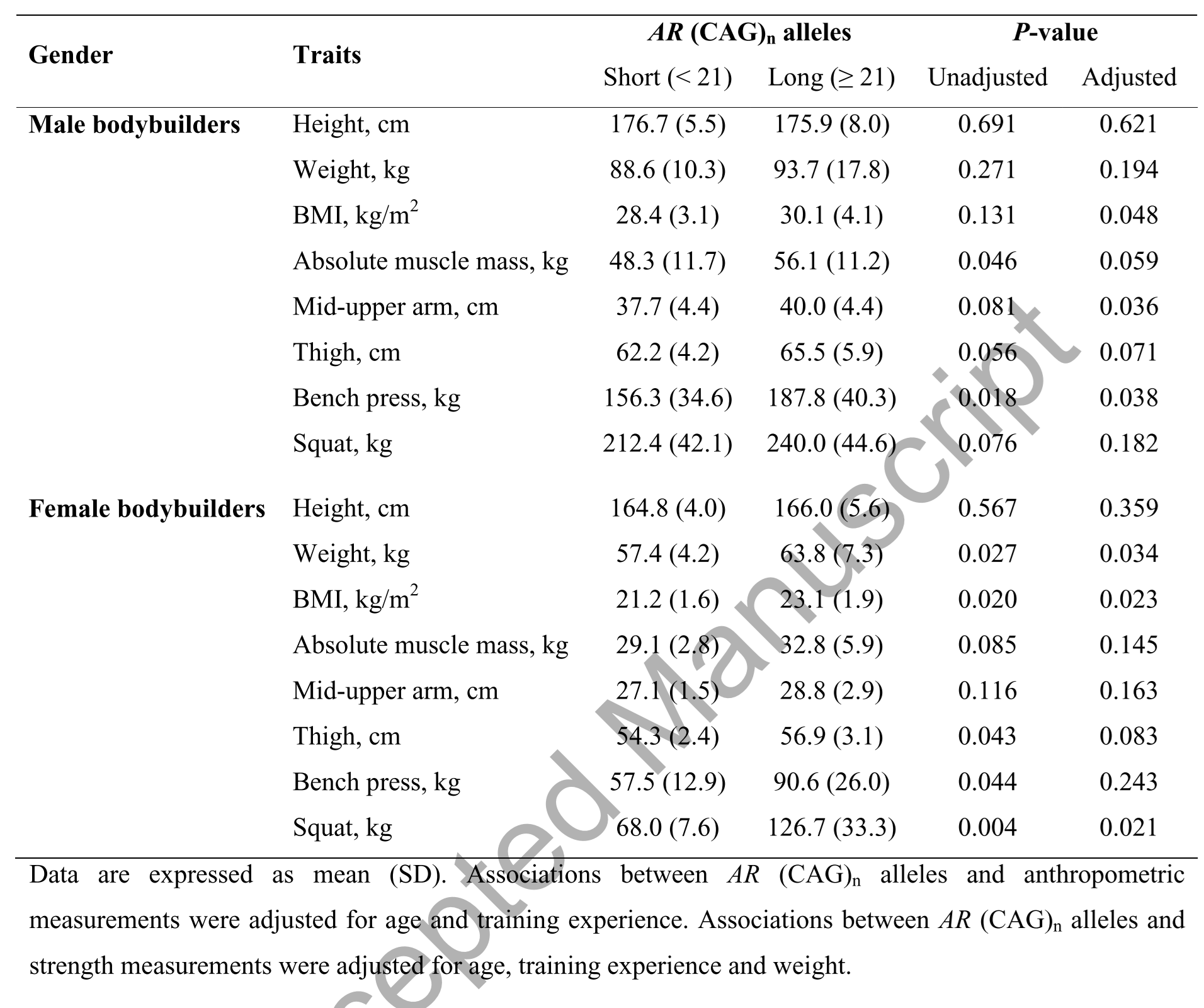
TL;DR - It appears that higher CAG repeats within the androgen receptor are associated with a slightly higher baseline concentration of testosterone. However, in large-sample cross-sectional studies, androgen receptor sensitivity does not seem to be related to lean body mass or fat mass. A Russian study investigating the relationship in bodybuilders and power lifters shows a fairly large difference in muscle mass and strength, favoring those with a higher number of CAG repeats. This particular finding warrants more research within this specific population.
REFERENCES:
1. Morton RW, S.K., Gallaugher MPB, Oikawa SY, McNicholas PD, Fujita S and Phillips SM, Muscle Androgen Receptor Content but Not Systemic Hormones Is Associated With Resistance Training-Induced Skeletal Muscle Hypertrophy in Healthy, Young Men. Front. Physiol., 2018. 9: p. 1373.
2. Ma, Y.M., et al., Relationships among androgen receptor CAG repeat polymorphism, sex hormones and penile length in Han adult men from China: a cross-sectional study. Asian J Androl, 2014. 16(3): p. 478–81.
3. Ryan, C.P., et al., Androgen receptor CAG repeat polymorphism and hypothalamic-pituitary-gonadal function in Filipino young adult males. Am J Hum Biol, 2017. 29(1).
4. Osadchuk, L., et al., Androgen Receptor Gene CAG Repeat Length Varies and Affects Semen Quality in an Ethnic-Specific Fashion in Young Men from Russia. Int J Mol Sci, 2022. 23(18).
5. Nielsen, T.L., et al., The impact of the CAG repeat polymorphism of the androgen receptor gene on muscle and adipose tissues in 20-29-year-old Danish men: Odense Androgen Study. Eur J Endocrinol, 2010. 162(4): p. 795–804.
6. Walsh, S., et al., Androgen receptor CAG repeat polymorphism is associated with fat-free mass in men. J Appl Physiol (1985), 2005. 98(1): p. 132–7.
7. Huhtaniemi, I.T., et al., Increased estrogen rather than decreased androgen action is associated with longer androgen receptor CAG repeats. J Clin Endocrinol Metab, 2009. 94(1): p. 277–84.
8. De Naeyer, H., et al., Genetic variations in the androgen receptor are associated with steroid concentrations and anthropometrics but not with muscle mass in healthy young men. PLoS One, 2014. 9(1): p. e86235.
9. Sasako, T., et al., The Influence of Trinucleotide Repeats in the Androgen Receptor Gene on Androgen-related Traits and Diseases. J Clin Endocrinol Metab, 2024. 109(12): p. 3234–3244.
10. Bhasin, S., Biologic Significance of the Short Tandem Trinucleotide Repeats in the Androgen Receptor Gene. J Clin Endocrinol Metab, 2025. 110(4): p. e1276–e1277.
11. Guadalupe-Grau, A., et al., Androgen receptor gene polymorphisms lean mass and performance in young men. Br J Sports Med, 2011. 45(2): p. 95–100.
12. Guilherme, J., et al., Androgen receptor gene microsatellite polymorphism is associated with muscle mass and strength in bodybuilders and power athlete status. Ann Hum Biol, 2021. 48(2): p. 142–149.
13. Campbell, B.C., et al., Androgen receptor CAG repeats and body composition among Ariaal men. Int J Androl, 2009. 32(2): p. 140–8.

Related Content
What Would It Take To Really Map Out The Androgen Signaling Network?
Jan 23, 2026
How Does Sleep and Sleep Loss Affect Testosterone?
Dec 05, 2025
Do Baseline Hormonal Values Matter For Hypertrophy Adaptations?
Nov 01, 2025